
Intent-Based Marketing – What Is It?
Intent-Based Marketing (IBM) is an intent driven marketing approach that combines data, context, user behavior, and timing. IBM is marketing driven by intent — by what a customer communicates through their actions. It helps you focus on the prospects who are most ready to buy and increases the chances they will convert.
Table of Contents
- What exactly is Intent-Based Marketing?
- Where does “intent data” come from?
- Intent-Based Marketing Campaigns
- Why IBM is more effective — key benefits
- How Intent-Based Marketing differs from ABM
- Implementing IBM — how to do it
- Best Practices for Intent-Based Marketing
- Limitations & pitfalls of IBM
- Useful tools to check
- Future of Intent-Based Marketing
Intent based marketing enables marketers to deliver personalized experiences, increase conversions, and achieve higher ROI by understanding and acting on customer intent.
What exactly is Intent-Based Marketing?
IBM is a strategy built around identifying and using so-called intent data — signals generated by users that reveal where they are in their buying decision. Instead of communicating broadly (mass marketing), IBM selects audiences who have already shown signs of interest and delivers personalized communication tailored to their current level of intent.
To put it simply: imagine a market with 100 companies. Out of those:
- 10 are ready to buy your product right now,
- 20 are hesitating and still comparing options,
- 70 are not interested at all.
These groups are segmented based on buyer intent, which helps marketers understand and prioritize companies according to their likelihood to purchase.
In IBM terms, these groups are: high-intent, medium-intent, and low-intent.
If you communicate with all 100 companies at once, your message has to be very generic — which means it won’t truly resonate with any of them. Intent-Based Marketing allows you to identify the 30 companies that show buying signals and tailor your messaging and actions specifically to them.
In practice this looks like:
- 10 high-intent companies → use strong, direct CTAs such as “Call us now to discuss your offer,” because they are actively searching for solutions and are close to making a decision.
- 20 medium-intent companies → they need a bit more time, so educational content works better: case studies, comparisons, guides.
Instead of wasting energy on the 70 uninterested companies, you invest your time and budget into those who are closest to converting. IBM helps identify prospects who are most likely to convert, ensuring your efforts are focused on the right opportunities. That’s the essence of intent-based marketing.
Where does “intent data” come from? (types & sources)
To run IBM effectively, you need data. Here are the most common sources:
Intent-based marketing relies on analyzing behavioral signals such as keyword searches, which help identify prospects actively seeking specific solutions. Additionally, monitoring website traffic can reveal valuable intent signals by tracking which companies visit your site, their engagement levels, and how they interact with your content.
First-party data:
Your own website and analytics — first-party intent data, which is data collected directly from your own website and analytics, includes visits, time on site, clicks, downloads, content interactions, and form submissions.
Third-party data:
Data collected outside your domain, known as third-party intent data—information gathered from external sources beyond your own domain such as partner platforms, comparison sites like G2 or Capterra, review portals, communities, and research platforms—allows you to detect intent before the prospect reaches you.
Behavioral activity signals:
Search queries (e.g., Google), content downloads, article views, meaningful on-page time, email engagement, social interactions, as well as the use of decision stage keywords and high intent keywords, are important indicators of user readiness to buy. All of this builds a picture of user intent.
Understanding search intent helps interpret these behavioral signals, allowing you to better align your marketing strategies with what users are actively seeking.
These signals can be used for lead scoring, segmentation, dynamic campaigns, and personalized messaging based on intent level.
High-Intent Prospects
High-intent prospects are the gold standard for any sales and marketing team. These are the individuals or companies who have demonstrated clear buying intent through their online behavior and engagement with your brand. They might visit your pricing pages, download in-depth resources like whitepapers, or interact with targeted ads—each action sending strong intent signals that they are actively considering a purchase.
Identifying high-intent prospects starts with collecting and analyzing intent data from both first-party and third-party sources. Intent-based marketing tools can help marketing teams track these signals in real time, allowing for precise segmentation and prioritization. By focusing your marketing efforts on these high intent prospects, you can deliver tailored content and personalized outreach campaigns that speak directly to their needs and stage in the buying journey.
For example, if a prospect spends significant time on your pricing page, your sales and marketing teams can respond with targeted messages or special offers designed to move them closer to a decision. This intent-based approach ensures that your resources are invested where they have the highest chance of converting leads into loyal customers.
Intent-Based Marketing Campaigns
Intent-based marketing campaigns are all about precision and relevance. Instead of casting a wide net, these campaigns use intent data and intent-based marketing tools to zero in on high-intent prospects who are already showing signs of purchase intent. By understanding where each prospect is in the buying journey, marketing teams can craft marketing messages and content that are highly personalized and timely.
A successful intent based marketing campaign might include dynamic email sequences, targeted ads, or personalized landing pages that address the specific interests and pain points of high intent prospects. These campaigns are designed to nurture leads with the right information at the right time, increasing the likelihood of conversion and driving revenue growth.
By leveraging intent data, businesses can ensure their marketing efforts are focused on the prospects most likely to buy, making every marketing dollar count. This approach not only boosts the effectiveness of marketing campaigns but also shortens the sales cycle and improves overall ROI.
Why IBM is more effective — key benefits
Higher performance & better ROI
Targeting people who have already shown interest dramatically increases conversion rates, as intent based marketing helps generate quality leads and supports lead generation by focusing on prospects with strong buying signals. Acting on intent raises the likelihood of closing the deal.
Smarter budget allocation
You invest in the audiences with the highest probability of converting. Additionally, predictive analytics can be used to analyze behavioral data and forecast which segments are most likely to convert, allowing you to further optimize budget allocation for maximum ROI.
Better message relevance & personalization
You tailor communication to the user’s stage in the customer journey: education → comparison → decision → purchase. It gives the impression that the brand truly understands the customer’s needs, strengthening trust and loyalty. Targeted advertising plays a key role in intent based marketing by enabling brands to deliver highly personalized messages based on user behavior and purchase intent.
Better marketing–sales alignment
Marketing can filter and pass only high-intent leads to sales, improving efficiency and lowering wasted effort.
How Intent-Based Marketing differs from ABM
Although the terms often appear together, they are complementary but fundamentally different in logic.
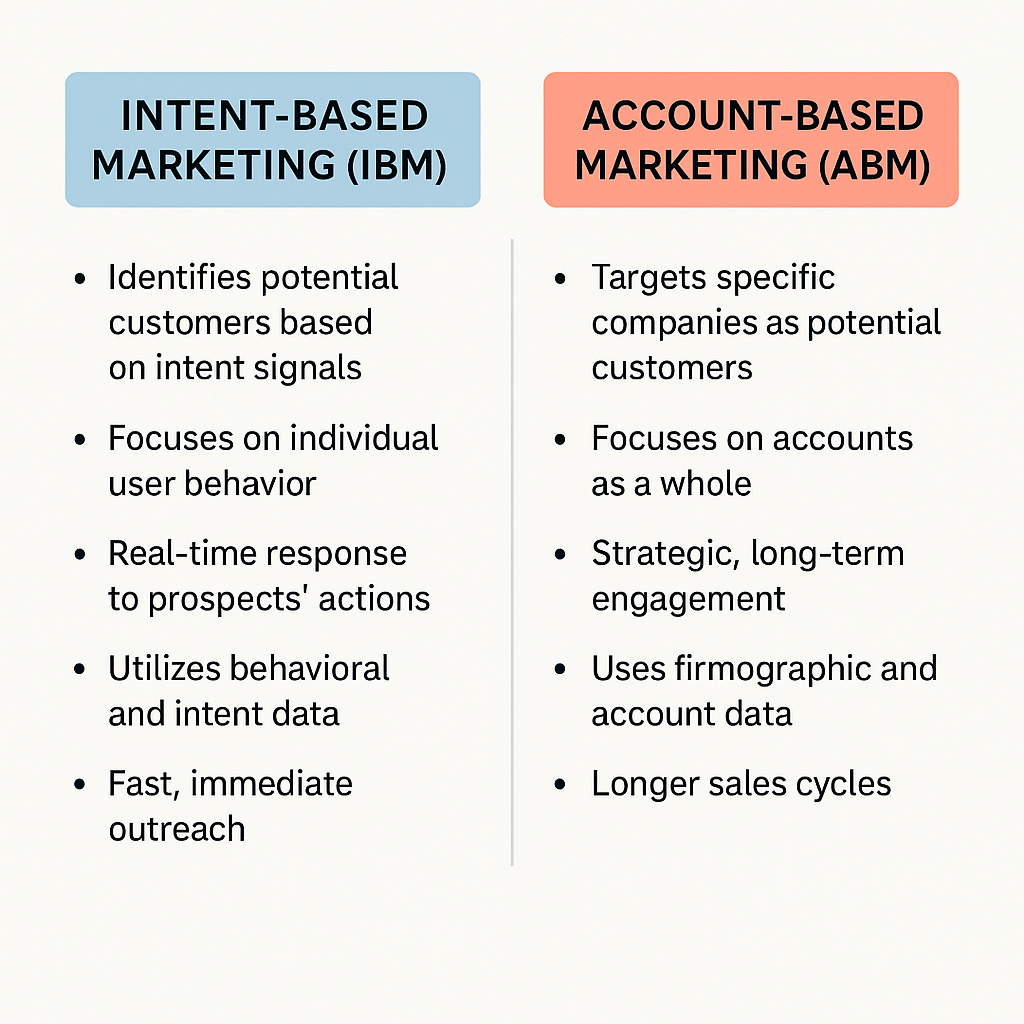
Intent-Based Marketing (IBM) starts with user behavior and real intent signals. It is a bottom-up approach: you observe who is showing interest right now and respond to that behavior. The user sends the first signal — with clicks, repeated visits, or comparison activity — and the brand’s role is to react quickly and precisely. IBM also enables marketers to segment and reach target users based on intent signals, ensuring that personalized messaging is delivered to those most likely to convert.
Account-Based Marketing (ABM) works the opposite way. You first choose the specific companies you want to acquire as customers, regardless of whether they currently show any buying intent. It is a top-down approach focused on carefully selected accounts and long-term, highly personalized engagement. The key to ABM success is identifying and targeting the right accounts at the optimal time, using data-driven insights to maximize impact.
The operational focus differs too. IBM emphasizes real-time reactions, automation, and dynamic personalization, which makes it perfect for inbound, lead gen, and e-commerce. ABM focuses on targeted campaigns aimed at selected companies, personalization at the account level, and long-term strategic programs for large B2B clients.
They also use different types of data. IBM relies mostly on behavioral signals: first-party intent (what users do on your site), third-party intent (what they do outside it), and content consumption patterns. Third party providers play a crucial role in supplying intent data, revealing prospects' research activities across the web and helping marketers make informed decisions. ABM depends primarily on firmographic data — industry, company size, region — and strategic account analysis, followed by long-term nurturing.
Speed is another major difference. In IBM, seconds or minutes matter — if a user shows intent now, the brand must act now. A typical example is when a user visits the pricing page and a CallPage callback widget instantly invites them to connect. In ABM, the cycle is longer and more deliberate — built over weeks or months.
Most importantly, these approaches work best together. ABM defines who you want as a customer. IBM tells you when to engage.
In practice: you have an ABM target list, IBM detects that some of those companies are showing buying signals, and at that exact moment you adjust your ads, activate sales reps, trigger a callback, or invite them to a demo.
This combination represents the future of high-performance B2B marketing — precise targeting + perfect timing.
Implementing IBM — how to do it
- Collect first- and third-party data; ensure you have the technology to track behavior (website analytics, marketing automation, sales intelligence). Incorporate keyword research to identify high-intent signals and optimize targeting.
- Define what “intent” means for your business — pricing page visits, searches, demo requests, downloads, etc.
- Build scoring and segments — determine what counts as low, medium, and high intent.
- Match communication and content to intent level — from education, through comparisons, to strong CTAs. Use targeted marketing content to engage prospects and personalize their experience.
- Align marketing and sales — pass only leads with real potential and coordinate actions. Sales outreach should leverage intent data for hyper-personalized engagement with high-intent prospects.
- Test, measure, optimize — IBM is an ongoing process, not a one-time campaign.
- A clear intent based marketing strategy and an intent driven marketing approach are essential for maximizing engagement and conversion throughout the buyer's journey.
Measuring and Optimizing Intent-Based Marketing
To get the most out of your intent-based marketing efforts, it’s essential to measure and optimize your strategies continuously. Start by tracking key performance indicators such as conversion rates, engagement metrics, and the progression of leads through the sales funnel. Analyzing these metrics helps you understand which marketing campaigns and tactics are driving results and which areas need improvement.
Based marketing thrives on actionable insights. By regularly reviewing campaign performance, you can identify patterns in customer behavior, refine your audience segments, and adjust your messaging for maximum impact. Use A/B testing to experiment with different approaches and leverage marketing automation tools to streamline your processes.
Optimization is an ongoing process. The more you learn from your data, the more effective your intent based marketing becomes—ensuring that your marketing efforts are always aligned with your business goals and the evolving needs of your target audience.
Best Practices for Intent-Based Marketing
To build successful intent-based marketing campaigns, it’s important to follow a set of proven best practices. Start by leveraging intent data from both first-party and third-party sources to gain a comprehensive view of your prospects’ online behavior and purchase intent. Use intent-based marketing tools to segment your audience and identify high intent leads.
Develop personalized and targeted marketing messages and content that speak directly to the needs and interests of each segment. Continuously monitor your marketing efforts, using analytics to track performance and uncover opportunities for optimization. Regularly update your strategies based on what the data reveals, ensuring your marketing campaigns remain relevant and effective.
By following these best practices, marketing teams can create intent based marketing campaigns that not only drive conversions and revenue growth but also foster deeper customer engagement and loyalty.
Limitations & pitfalls of IBM
IBM only works when based on good data. If behavioral information is incomplete or misinterpreted, it’s easy to draw wrong conclusions and waste budget on users who never intended to buy. This can lead businesses to waste money on inefficient campaigns or misallocated resources, highlighting the importance of a strategic approach to intent based marketing.
Not every interaction equals intent — someone may read your blog or download resources out of curiosity. This is why distinguishing between intent levels is crucial. IBM also requires the right tools and processes; without analytics, scoring, and strong marketing–sales alignment, it’s hard to interpret “intent” properly. There’s also the risk of over-automation, which can make users feel treated like database entries rather than people.
The biggest limitation, however, is restricted data visibility. No tool can see the full customer journey — browsing competitors, researching offline, reading comparisons on external sites. Each source covers only a fragment of the path, so intent interpretation is always incomplete. Even the best systems operate within a degree of uncertainty, and brands must use intent data with care.
A few useful tools
The list of tools supporting Intent-Based Marketing is long, but here are several worth checking out — ones that genuinely help detect people or companies showing real buying intent. Some of these tools even offer a free report with valuable industry insights or trend analysis to attract and engage potential users.
G2 Buying Intent
Shows which companies and individuals are viewing your profile, comparing you with competitors, or browsing your category. A very strong buying signal — but the Buying Intent packages are expensive (several thousand dollars per month).
HubSpot
Doesn’t identify new users, but perfectly tracks intent among the contacts already in your CRM. It assigns behaviors to specific people: pricing page visits, email opens, clicks on case studies, return visits. Lead scoring makes it easy to see who is “warming up.”
CallPage
Captures intent the moment it appears — pricing page, product page, exit intent. It calls the user back within 28 seconds, books meetings, or routes the interaction to an AI Voice Agent. It doesn’t just detect intent — it turns it into a conversation instantly.
Clearbit Reveal
Identifies companies visiting your website, even if the user is anonymous. You see which company viewed your pricing, features, or product content. Great for early-stage account intent detection.
6sense
Analyzes which companies are in research, comparison, or buying mode. Scores intent based on external data and historical behavior. Blends ABM and IBM extremely well.
ZoomInfo Intent
Shows exactly which individuals are researching topics related to your solution, along with contact details. Perfect for SDR teams.
Dealfront (formerly Leadfeeder)
Reveals which companies revisit your website, what they view, and how often. A simple, effective IBM tool for sales teams, especially those just beginning with intent-driven workflows.
Future of Intent-Based Marketing
The future of intent-based marketing is bright, driven by rapid advancements in technology, data analytics, and artificial intelligence. As businesses continue to harness intent data and intent-based marketing tools, we’ll see even greater levels of personalization and targeting. Machine learning and AI models will evaluate vast amounts of behavioral signals in real time, enabling marketing teams to predict purchase intent with unprecedented accuracy.
This evolution will empower brands to deliver hyper-relevant marketing messages and content at every stage of the buyer journey, creating seamless and engaging customer experiences. As intent based marketing becomes more sophisticated, expect to see more automation, smarter segmentation, and deeper integration with sales strategies.
Staying ahead in this landscape means embracing new technologies and continuously refining your based marketing approach—ensuring your business remains competitive and your marketing efforts deliver maximum impact.
Conclusions & recommendations
Intent-Based Marketing is one of the most effective ways to:
- improve conversion rates and lead quality,
- save budget and resources,
- deliver communication aligned with real customer needs,
- strengthen sales–marketing alignment,
- gain a competitive advantage — especially in B2B and SaaS.
For best results, consider developing a comprehensive intent based marketing strategy that identifies high-intent signals, segments audiences, and optimizes campaigns through tracking and testing. Incorporating intent marketing into your overall plan will help you better understand customer behavior, target prospects more effectively, and maximize your marketing ROI.
It’s absolutely worth including in your marketing strategy for 2026.
Check out other posts
Start generating leads today!
Start a 14-day free trial now,
set up the widget on your site, and see how many more leads you can capture with CallPage
- No credit card required
- 10 minutes set up
- 14 days fully-features free trial