Conversational Marketing: Why Conversation Is Once Again More Effective Than Forms
Just a few years ago, online marketing followed a fairly predictable pattern: ad → landing page → form → we’ll get back to you within 24–48 hours. Today, this model increasingly fails to deliver results.
Table of Contents
- How Is Conversational Marketing Different From Traditional Marketing?
- Why Does Response Time Matter So Much Today?
- What are the stages of Conversional Marketing?
- CallPage: voice-first conversational marketing in practice
- Understanding the Customer Journey in Conversational Marketing
- What Results Does Conversational Marketing Deliver?
- What KPIs Are Used in Conversational Marketing?
- Conversational Marketing Tools — How to Choose the Right Ones?
- Building Customer Loyalty Through Conversational Marketing
- Best Practices for Conversational Marketing Success
- Common Mistakes in Conversational Marketing Implementation
- The Future of Conversational Marketing: Trends to Watch in 2026 and Beyond
- Top 10 Conversational Marketing Tools (2026)
Customers are used to immediacy. When they have a question, they expect an answer now — not tomorrow. When they’re interested in an offer, they want a conversation, not another automated confirmation email. This shift in expectations is exactly where conversational marketing comes from. Conversational marketing is often considered a part of an inbound marketing strategy, and both approaches are customer-centric and aim to enhance customer experience.
Conversational marketing is a way of thinking about communication in which dialogue replaces one-way messaging, and response speed becomes a key source of competitive advantage. Meaningful conversations and real-time conversations are central to this approach, enabling immediate, personalized support across multiple channels and enhancing the customer journey.
In this article, we’ll look at conversational marketing from a practical perspective: what it is, why it works, how it’s implemented, and what to pay attention to.
How Is Conversational Marketing Different From Traditional Marketing?
The core difference is simple: monologue versus conversation.
From the user’s perspective, it looks like this:
- instead of a long form — a short interaction,
- instead of waiting for a response — an immediate reply,
- instead of an anonymous lead — a conversation with a real person or an intelligent AI system.
This approach doesn’t eliminate traditional marketing channels. Instead, it focuses on enabling instant contact and fast problem resolution at the moment when the user actually needs it. Conversational marketing also enables the delivery of targeted messages that address specific customer needs in real time, unlike the one-size-fits-all approach of traditional marketing.
Why Does Response Time Matter So Much Today?
In the digital world, time works against the seller. Every minute of delay means:
- lower engagement,
- greater susceptibility to competitors’ offers,
- a smaller chance of a meaningful sales conversation.
Market research has consistently shown that the faster a company responds to an inquiry, the higher the likelihood of successful lead qualification. In practice, a response after a few minutes has a completely different value than a response after a few hours.
This isn’t just theory. Back in 2019, CallPage ran a simple experiment that clearly illustrated the impact of response time on conversion rates.
Four versions of the same landing page were created. Each had the same design, content, and traffic sources — driven by identical ad campaigns. The only variable was the declared response time in the contact form:
- up to 24 hours
- up to 1 hour
- up to 15 minutes
- up to 30 seconds
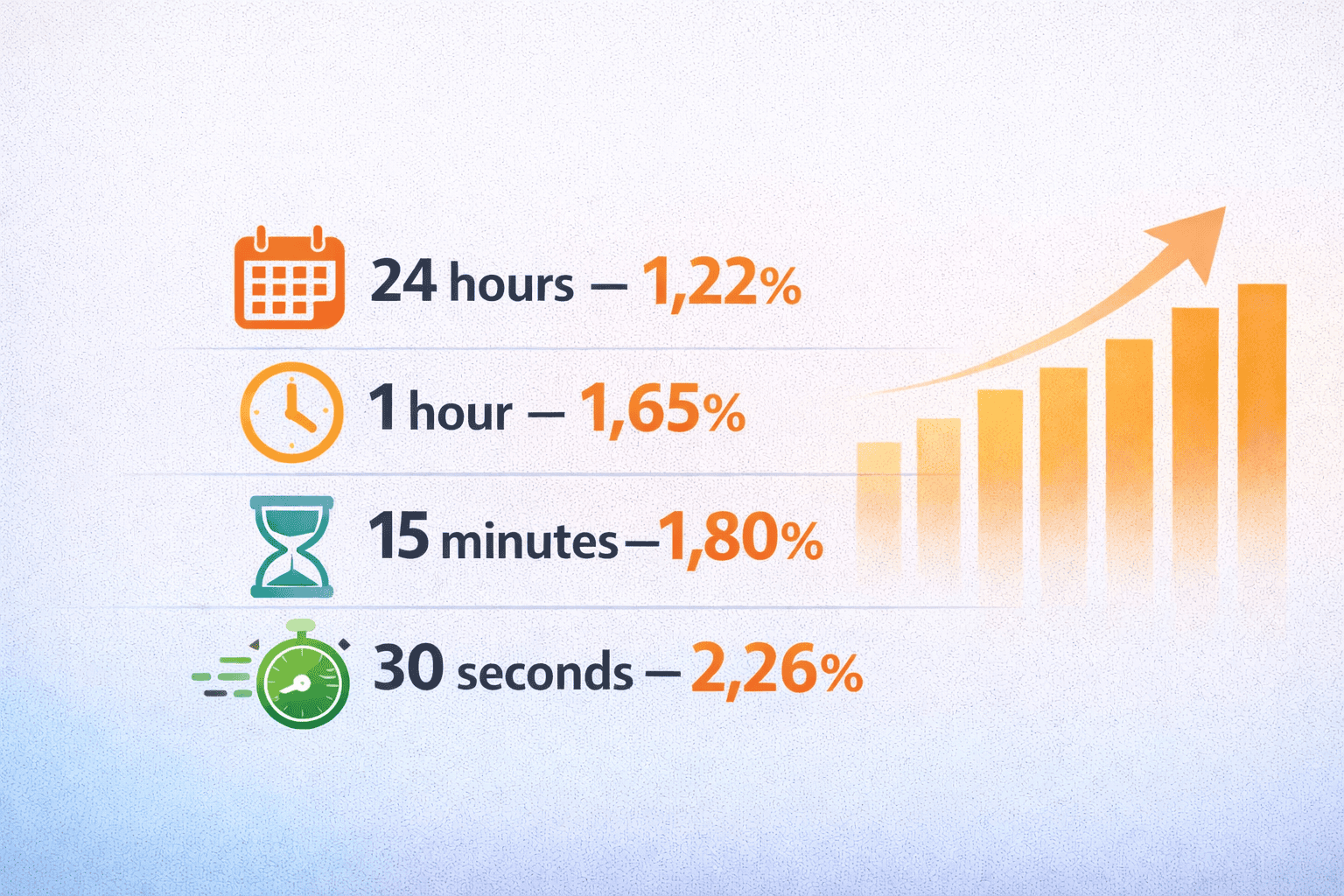
After several weeks, the results were compared. The same landing pages achieved very different conversion rates:
- 24 hours — 1.22%
- 1 hour — 1.65%
- 15 minutes — 1.80%
- 30 seconds — 2.26%
The difference was significant. Reducing the declared response time from 24 hours to 30 seconds increased conversion by over 85% (from 1.22% to 2.26%).
These percentages become even more compelling when viewed in the context of real traffic. With 20,000 monthly visitors:
- a 1.22% conversion rate means roughly 244 leads,
- a 2.26% conversion rate results in around 452 leads.
That’s more than 200 additional leads per month (how to calculate cost per lead), generated solely by shortening response time — without changing ad spend, offer, or creatives.
Importantly, user expectations have only increased since this test was conducted. Today, customers are even less willing to wait, and the promise “we’ll call you tomorrow” is increasingly discouraging. At the same time, the market offers marketers more tools than ever to reduce response time — from callbacks and chat, to AI agents. Unlike traditional support limited by business hours, chatbots and conversational tools can provide 24/7 support by answering common questions and qualifying leads for further engagement.
This leads to an important question: if you’re still focused mainly on increasing the number of leads, maybe it’s time to start chasing deals instead of leads. In the end, what matters isn’t how many forms were submitted, but how many conversations actually turned into customers.
What are the stages of Conversional Marketing?
Effective conversational marketing isn’t about random conversations. Conversational marketing works as a customer-centric, dialogue-driven approach that involves interactive, real-time communication with prospects and customers through digital channels, unifying marketing, sales, and customer service efforts to create a cohesive customer experience. It’s built on a simple, repeatable framework that supports users at every stage of the decision-making process.
Engage — Start the Conversation at the Right Moment
The first step is initiating contact when the user shows real intent. This may include:
- spending a longer time on an offer page,
- visiting the pricing page,
- returning to our page.
Conversational marketing tools, such as chatbots and callback tools, can start conversations with website visitors at these key moments by engaging them in real-time based on their behavior.
At this point, a conversation prompt appears — neutral, helpful, and non-intrusive. Its goal isn’t immediate selling, but opening a dialogue.
Understand — Understand Needs Instead of Collecting Data
Once the conversation begins, quickly understanding context becomes critical. Instead of long forms, 2–3 well-phrased questions are often enough.
Modern conversational marketing systems can:
- conduct short qualification in natural language,
- collect only essential information,
- route the conversation to the right person or team,
- use AI Agents to automate gathering data and answering frequently asked questions, efficiently providing information about products and services.
For many organizations, this is the moment when a lead stops being anonymous and starts to have real sales value.
Recommend — Suggest the Next Logical Step
A good conversation always leads to a clear next action. This might be:
- booking a meeting,
- handing the conversation over to a sales rep or sales team,
- scheduling contact for another time,
- or resolving the issue during the first interaction.
The key is that the user doesn’t have to guess what happens next. Conversational marketing shortens the path from question to decision.
CallPage: voice-first conversational marketing in practice
“There is no single ‘best’ channel in conversational marketing. For some audiences, chat feels natural. For others, a phone call is still the fastest and most trusted way to connect. The real challenge is not choosing the trendiest tool, but designing conversations that meet customers where they are — and responding fast enough to turn intent into a real dialogue.” Wioleta Szybowska, Head Of Sales and Marketing, CallPage
You can use many different tools to organize conversational marketing in your company, but their effectiveness depends largely on how your customers actually want to communicate. In some industries chat works well, while in others voice remains the most natural and trusted way to start a conversation — especially when speed and clarity matter.
CallPage fits into this voice-first approach to conversational marketing by focusing on fast, frictionless phone interactions triggered directly from digital touchpoints.
Engage
The conversation starts with a callback invitation displayed at the right moment. Visitors can request a call by entering only their phone number — no long forms, no unnecessary steps. The message is simple: we’ll call you back in 28 seconds. This removes friction and allows users to get answers without searching through pages or guessing where to go next.
Understand
Once the callback is triggered, the AI Voice Agent can handle the first interaction. It answers the call, responds to common questions, explains the offer, and performs initial qualification. At this stage, the goal is to identify whether there is a real need and whether the conversation should be passed to a human team member.
Recommend
The final step is guiding the customer toward the most logical next action. This may be a direct call with the best-matched person on the team (using AI routing), scheduling a meeting, or sending a follow-up SMS with a clear next step. The conversation doesn’t end abruptly — it moves forward in a structured way.
Understanding the Customer Journey in Conversational Marketing
A successful conversational marketing strategy starts with a deep understanding of the customer journey. Today’s customers interact with brands across multiple channels—messaging apps, social media, and company websites—expecting seamless, real-time engagement at every stage. By mapping out the customer journey, businesses can pinpoint the moments when customers are most likely to need support, have questions, or seek reassurance.
For example, a visitor lingering on a pricing page or returning to a product detail page may be signaling interest or uncertainty. This is the perfect opportunity to initiate a personalized conversation, answer frequently asked questions, and address any customer concerns. By leveraging messaging apps and social media platforms, companies can engage customers where they are most comfortable, providing personalized support that feels natural and immediate.
A well-crafted conversational marketing strategy doesn’t just resolve issues—it builds lasting customer relationships. By being present at key touchpoints and offering meaningful, one-on-one conversations, businesses foster customer loyalty and create a positive brand experience that extends well beyond the initial purchase.
The Role of Consumer Behavior in Conversational Marketing
Understanding consumer behavior is at the heart of any effective conversational marketing strategy. By analyzing how customers interact with your brand—what channels they use, when they’re most active, and what types of messages prompt engagement—businesses can tailor their marketing strategy to better meet the needs of their target audience.
Insights into consumer behavior help identify the most effective messaging platforms, whether it’s live chat on your website, social media messaging, popular apps like WhatsApp or automated phone callback. Recognizing patterns in customer interactions allows businesses to time their outreach for maximum impact and craft conversations that address specific pain points.
What Results Does Conversational Marketing Deliver?
Companies that adopt this communication model typically see improvements in three main areas. Conversational marketing tools are highly effective for lead generation, enabling businesses to attract new leads, qualify them in real time, and ultimately reach more customers. Additionally, conversational marketing can provide valuable insights into customer behavior, which can be used to inform and optimize marketing strategies.
Shorter Sales Cycles
Conversations happen when buying intent is highest. Conversational marketing helps guide prospects through the buying journey more efficiently, reducing delays and accelerating decision-making. Instead of calling back “cold” leads days later, teams speak with people who are actively seeking contact.
Better Use of Existing Traffic
Conversational marketing doesn’t require higher ad budgets. Its main advantage lies in improving conversion from traffic that’s already reaching the site. Integrating conversational marketing with marketing campaigns can further enhance conversion rates by engaging visitors in real time.
Higher-Quality Customer Experience
For users, simplicity and responsiveness matter most. A short text or voice conversation often builds more trust than even the most polished automation.
Providing a personalized experience and facilitating valuable conversations are essential for building customer loyalty, as conversational marketing delivers immediate, personalized support across multiple channels.
What KPIs Are Used in Conversational Marketing?
In conversational marketing, it quickly becomes clear that traditional metrics — such as clicks or page views — are no longer enough. Interactions alone say little about conversation quality or revenue impact.
That’s why teams focused on conversational marketing track metrics tied directly to dialogue and business outcomes. The key benefits of conversational marketing include improved engagement, greater efficiency in customer interactions, and higher customer satisfaction, all achieved by optimizing everyday conversational tools.
Collecting feedback from customers is essential for further developing and optimizing your conversational marketing strategy.
Key Conversational Marketing KPIs
Meetings booked / meetings held
Not just how many meetings are scheduled, but how many actually happen. A high “held” rate usually indicates strong lead qualification during the conversation.
Pipeline Velocity
The speed at which leads move through the sales funnel. Conversational marketing directly improves this metric by removing delays and shortening the time between interest and conversation.
Post-conversation CSAT and NPS
Customer satisfaction measured immediately after a chat or call helps quickly identify friction points and continuously optimize conversation flows.
Cost Per Opportunity (CPO)
The total cost of generating a qualified sales opportunity. In practice, companies often see significantly lower CPO with well-implemented conversational marketing compared to traditional lead campaigns.
Conversational Marketing Tools — How to Choose the Right Ones
Today’s market offers a wide range of solutions: chatbots, live chat, callback systems, voice AI, and meeting scheduling platforms. The main communication channels for conversational marketing include live chat, chatbots, SMS, phone, WhatsApp, and Facebook Messenger, providing multiple touchpoints for customer engagement. Tool selection should be driven not by trends, but by real team needs.
For many companies, the key factors include:
- speed of implementation,
- the ability to reduce response time,
- smooth transition from online interaction to conversation,
- alignment with their audience and sales process.
It’s worth considering which type of interaction your potential customers prefer most — chat, video, online meeting, or phone call. Identifying and utilizing customers' preferred channels, especially on mobile phones where a significant portion of interactions now occur, is crucial for effective engagement. Preferences vary by industry and market, and the better the match, the higher the chance of conversion.
For teams evaluating text-based communication as part of their conversational strategy, G2's in-depth guide on SMS marketing software offers a comprehensive overview of tools, use cases, and buyer considerations.
Building Customer Loyalty Through Conversational Marketing
Conversational marketing is a powerful driver of customer loyalty because it puts the customer experience front and center. When businesses engage customers in real time, offering immediate value by answering questions and resolving concerns, they create a sense of trust and reliability that’s hard to replicate with traditional marketing methods.
Personalized support—delivered through live chat, messaging apps, phone, or social media—shows customers that their needs are a priority. This not only enhances the immediate customer experience but also encourages repeat business and long-term loyalty. Even after a purchase, ongoing conversations—such as follow-up messages, exclusive offers, or helpful content—keep your brand top of mind and reinforce the relationship.
By focusing on customer loyalty, businesses can reduce churn, increase customer lifetime value, and build a base of enthusiastic advocates who are more likely to recommend your brand to others. In a competitive market, these loyal customers are a key asset for sustainable growth.
Best Practices for Conversational Marketing Success
To maximize the benefits of conversational marketing, businesses should follow a set of proven best practices. Start by defining a clear conversational marketing strategy that aligns with your overall marketing strategy and business goals. Choose messaging platforms that your potential customers prefer, whether that’s live chat, social media messaging, or dedicated apps.
Leverage marketing automation tools to streamline customer interactions and ensure that personalized conversations happen at scale. However, always provide a seamless transition from automated chatbots to human sales reps when needed, so customers feel supported throughout their journey.
Continuously optimize your approach by gathering feedback, analyzing customer behavior, and refining your messaging. Prioritize customer engagement by making every interaction relevant and valuable, which will help generate quality leads and convert potential customers into loyal advocates.
By following these best practices, your conversational marketing strategy will not only drive more leads but also create lasting customer relationships that fuel long-term business success.
Common Mistakes in Conversational Marketing Implementation
Despite its potential, many implementations fall short. The most common reasons include:
- automation with no option to reach a human,
- overly aggressive sales messaging,
- lack of consistency between chat, phone, and CRM,
- conversations that don’t reflect real user needs.
Conversational marketing should support conversation, not get in its way. Chatbots are just a part of conversational marketing, which also includes other forms of real-time, personalized, multi-channel interactions. Standardizing elements of conversations helps ensure professionalism and consistency in customer interactions.
The Future of Conversational Marketing: Trends to Watch in 2026 and Beyond
Looking ahead, several trends are set to redefine conversational marketing in 2026 and beyond. Artificial intelligence (AI) and machine learning (ML) are becoming integral to conversational marketing tools, enabling businesses to deliver highly personalized, efficient customer interactions at scale. These technologies can analyze previous interactions, predict customer needs, and provide instant, relevant responses.
Messaging platforms like Facebook Messenger, WhatsApp, and others are emerging as primary channels for customer engagement, allowing brands to meet customers where they already spend their time. The integration of conversational marketing tools with these platforms ensures that customer interactions are seamless and consistent across all touchpoints.
Phone conversations are making a comeback as a preferred channel for high-intent interactions. Many customers still find voice more natural than writing messages or joining video calls, especially when they need quick clarification or reassurance. What’s changing is scalability: AI voice agents now allow companies to handle phone conversations more efficiently, reducing reliance on large support teams while preserving the human experience customers value. As a result, voice-first conversational tools are becoming an increasingly important part of modern conversational marketing strategies (e.g., platforms like CallPage).
Voice-activated assistants such as Alexa and Google Assistant are also changing the landscape, offering new ways for customers to interact with brands using natural language. As these technologies become more widespread, conversational marketing will play an even greater role in the overall marketing strategy, helping businesses stay ahead of evolving consumer expectations.
By embracing these trends and continuously innovating, companies can ensure their conversational marketing efforts remain effective, relevant, and a key driver of exceptional customer engagement in the years to come.
Top 10 Conversational Marketing Tools (2026)
Also, check the complete list of 28 conversational marketing platforms you should try in 2026.
1. Drift (Salesloft)
One of the most recognizable conversational marketing platforms in B2B. Drift focuses on accelerating the sales pipeline through website conversations, account-based marketing (ABM), and intelligent routing of leads to the right sales representatives. It is most commonly used by larger SaaS sales teams.
2. Intercom
A platform that combines live chat, chatbots, and customer support in a single system. Intercom is particularly strong in customer experience and support use cases, and with its AI agent (Fin), it enables automated, knowledge-base-driven responses at scale. Widely adopted by SaaS companies handling high volumes of customer interactions.
3. HubSpot Conversations (Breeze)
Part of the HubSpot ecosystem and tightly integrated with its CRM. This tool enables real-time website conversations, automated data collection, and lead qualification based on CRM context. It works especially well for companies looking to connect marketing, sales, and customer data in one environment.
4. LiveChat
A classic but still widely used live chat tool, especially popular in e-commerce and service-based businesses. LiveChat focuses on fast, text-based communication with website visitors and integrates easily with customer support systems. Often used as a first point of contact on websites.
5. Tidio
An all-in-one conversational platform designed for SMBs and e-commerce. Tidio combines live chat, AI chatbots, and communication automation, enabling real-time customer support as well as automated responses to common questions. A popular choice for online stores.
6. ManyChat
A tool focused on conversational marketing within messaging platforms, primarily Facebook Messenger and Instagram. ManyChat allows businesses to build automated conversation flows, lead generation campaigns, and sales interactions directly inside social media channels. Commonly used in DTC and performance marketing.
7. Respond.io
A platform designed to manage conversations across multiple channels, including WhatsApp, Messenger, Instagram, and live chat. Respond.io enables teams to build AI agents and workflows for sales and customer support, making it a strong option for omnichannel communication strategies.
8. Zendesk Messaging
An extension of the Zendesk ecosystem focused on conversational customer support. It enables real-time and asynchronous conversations while preserving full interaction history. Most often used by customer support teams operating at scale.
9. Freshchat (Freshworks)
Part of the Freshworks suite, aimed at companies looking for a simpler implementation of conversational marketing and customer support. Freshchat offers live chat, chatbots, and integrations with CRM and helpdesk tools, making it suitable for mid-sized organizations.
10. CallPage
A conversational marketing platform focused on voice-first interactions and instant phone contact. CallPage connects digital touchpoints (such as websites and campaigns) with callbacks and AI voice agents, enabling fast transitions from user intent to real conversations. It is particularly popular among service-based businesses and sales teams where phone conversations remain a key step in lead journey.
Summary
Conversational marketing supports customers throughout the buying process and purchasing journey by integrating marketing and sales efforts as part of a broader inbound marketing approach. It provides valuable insights into customer behavior, such as past purchases, which can be used to personalize future interactions and improve the overall experience.
Regardless of whether a conversation starts via chat, a form, or a phone call, the same elements remain critical: response time, understanding intent, and quickly moving toward a solution.
This is where conversational marketing stops being a buzzword and starts having a real impact on sales performance and customer experience.
Conversational Marketing – FAQ
1. What is conversational marketing?
Conversational marketing is a marketing strategy that focuses on real-time, personalized dialogue with customers and prospects using digital channels like live chat, chatbots, messaging apps, phone or voice systems. It replaces one-way messaging with interactive communication that engages users and drives conversion.
2. How does conversational marketing work?
Conversational marketing works by initiating conversations at key moments in the customer journey — for example when a visitor is browsing pricing or product pages. Tools like chatbots, live chat or callback widgets engage users, ask relevant questions, and guide them toward the next step, such as scheduling a meeting or contacting sales.
3. What are the main tools used in conversational marketing?
The main tools used in conversational marketing include:
- Chatbots and live chat allowing text-based conversations.
- Messaging apps like WhatsApp and Facebook Messenger.
- Phone callbacks and AI voice agents for voice-based interaction.
- SMS and email automation for follow-ups and next actions.
4. Why is conversational marketing important?
Conversational marketing is important because customers now expect immediate responses and personalized support. It shortens response time, increases engagement, reduces friction in the buying process, and helps businesses convert more leads by meeting customers where they are.
5. How is conversational marketing different from traditional marketing?
Traditional marketing typically uses one-way communication (ads, forms, email blasts). Conversational marketing, on the other hand, creates dialogue — it invites real-time interaction and feedback from users rather than just delivering messages to them.
6. Can conversational marketing improve sales?
Yes. Conversational marketing improves sales by engaging leads when their buying intent is highest, helping to qualify them faster, answering questions instantly, and guiding them directly toward purchase or meaningful next steps.
7. What metrics are used to measure conversational marketing success?
Key metrics for conversational marketing include:
- Lead qualification rate
- Conversion rate
- Response time
- Meetings booked or sales calls held
- Customer satisfaction from interactions
8. What are best practices for conversational marketing?
Best practices include:
- Start conversations at the right moment based on customer intent.
- Use automation to speed up responses but allow smooth transition to human agents.
- Personalize interactions.
- Track performance and improve flows based on data.
9. What mistakes should be avoided in conversational marketing?
Common mistakes to avoid are:
- Over-automation without access to a human.
- Sales-first messaging that interrupts customer experience.
- Conversations that do not reflect user needs or behavior.
- Lack of channel consistency (e.g., chat, phone, CRM)
Check out other posts
Start generating leads today!
Start a 14-day free trial now,
set up the widget on your site, and see how many more leads you can capture with CallPage
- No credit card required
- 10 minutes set up
- 14 days fully-features free trial