
AI Phone Receptionist – A Complete Guide
An AI receptionist automates key customer service processes such as appointment scheduling or responding to routine inquiries while providing flexibility and 24/7 availability. In this article, we explain what an AI receptionist is, how it works, where it fits best in business, and what to look for when choosing a tool.
Table of Contents
- What is an AI receptionist?
- How is AI different from IVR?
- How does an AI receptionist work?
- What business problems does an AI receptionist solve?
- Common use cases for AI in phone support
- AI receptionist vs. traditional call center
- AI tools for phone automation
- Integrations with other systems
- Choosing the best AI receptionist
- Setting up an AI receptionist
- CallPage AI Voice Agent – how it works
- FAQ – frequently asked questions
The number of phone calls in companies keeps growing, and with it the problem of missed calls. According to various studies, up to 85% of customers whose call goes unanswered never call back. Traditional approaches to handling phone calls have clear limits: employees are sometimes unavailable, and classic IVR systems often frustrate callers with rigid menu options. An AI front desk acts as a virtual receptionist system that automates customer interactions and is available 24/7, ensuring no call goes unanswered.
Modern AI phone solutions use AI technology to answer calls, capture leads, and schedule appointments, providing a cost-effective alternative to human receptionists. They are changing the way companies answer and manage phone calls.
What is an AI receptionist?
An AI receptionist is an artificial intelligence–powered system that can independently answer phone calls, hold natural conversations with customers, understand the context of what they say, and respond appropriately - without human involvement.
Unlike traditional recordings or voice menus, an AI voice agent can understand freely spoken sentences, ask follow-up questions, provide information, and route the call to the right person or department. AI powered receptionists and virtual assistants can manage customer interactions 24/7, providing a reliable alternative to traditional front desk staff.
Virtual receptionists use advanced voice AI technologies to handle incoming calls and interact seamlessly with callers.
How is AI different from IVR?
Many companies already use IVR (Interactive Voice Response) systems—the familiar menus like “Press 1 for…”. However, IVR and AI are fundamentally different solutions.
- IVR works based on predefined paths - Customers must choose an option from a menu, and any deviation from the script often leads to errors.
- AI understands natural speech - Customers speak normally, and the agent interprets their intent—even if the wording doesn’t match any predefined pattern. AI receptionists use natural language processing (NLP) to understand spoken language and hold real-time conversations with callers.
- IVR is static - Any changes require system reprogramming.
- AI learns and adapts - It can be updated through a knowledge base and gradually becomes better at understanding a company’s specific context. An AI workforce can operate around the clock, handling tasks such as call capture and appointment scheduling without human intervention, ensuring continuous operational efficiency.
Compared to traditional IVR systems, AI voice agents provide much greater flexibility and effectiveness, improving both customer experience and operational efficiency.
How does an AI receptionist work?
Handling a call with AI happens in several steps. The entire process takes place in real time within fractions of a second:
- Call reception - The agent answers incoming calls through a virtual phone number or via a website widget.
- Speech recognition (ASR) - The customer’s speech is converted into text using Speech-to-Text technology.
- Intent analysis (NLU) - The AI analyzes the message and its context to understand what the caller needs.
- Response generation (LLM) - Based on the company’s knowledge base and the conversation context, a language model generates an accurate response.
- Speech synthesis (TTS) - The response is converted into natural-sounding speech and delivered to the caller.
- Call routing - If needed, the agent transfers the call to the appropriate person or department.
- Data recording - The AI receptionist captures caller details, including name, phone number, and caller’s intent, and automatically logs this information in the CRM. It also captures lead details during the interaction, ensuring all relevant information is documented for follow-up and conversion tracking.
Modern voice agents not only store data but also generate conversation summaries and extract key data, which can be automatically added to a CRM system. The system captures key details and call transcripts, which are organized in a centralized dashboard for easy review and analysis, supporting more effective sales call tracking.
All conversations and inquiries are documented and available for analysis, allowing companies to continuously improve customer service. AI receptionists can provide valuable data-driven insights into customer interactions, helping businesses understand call patterns and improve service.
The same automation can also apply to text channels such as SMS or Messenger, and it can integrate with business systems like Google Calendar, Microsoft Outlook, and CRM platforms such as HubSpot or Pipedrive. AI receptionists can send SMS follow-ups with any information the caller requests, such as forms, instructions, links, and contact details.
Importantly, modern voice agents are not limited to one language - many now support multilingual conversations.
What business problems does an AI receptionist solve?
An AI receptionist addresses several common challenges faced by companies that handle customer calls.
- Missed calls
The agent is always available, even when the team is busy or outside the office. AI receptionists provide 24/7 availability, ensuring businesses never miss calls, even outside of regular business hours.
- Overloaded teams
Repetitive questions (opening hours, pricing) no longer require employee involvement. AI receptionists excel at managing calls and handling customer inquiries efficiently, ensuring that no questions or needs go unanswered.
- Lack of time within the team
Salespeople and specialists can focus on tasks that require real expertise.
- Slow response times
Customers receive answers immediately instead of waiting in queues. AI receptionists can handle calls and perform front desk tasks such as answering questions, scheduling appointments, and routing inquiries.
- Inconsistent service
AI always responds according to predefined standards and the current knowledge base.
Benefits of implementing an AI phone receptionist
Implementing an AI receptionist can bring several advantages, especially for small businesses seeking to maximize efficiency and customer engagement. The ai answering service benefit includes cost savings, improved availability, and the ability to handle high call volumes—addressing common challenges faced by small businesses, particularly when trying to improve lead response time.
- Improved availability
The AI agent handles calls 24/7, ensuring no customer inquiry is missed and capturing leads outside of regular business hours, which can lead to increased revenue opportunities.
- Lower operational costs
AI receptionists can significantly reduce operational costs compared to hiring human staff, with the cost being 10-20 times cheaper than a full-time human receptionist. Businesses can save costs by using AI receptionists to manage high call volumes without the need for additional staff.
- Increased productivity
Implementing an AI receptionist allows your team to focus on higher-value tasks instead of routine call handling, leading to increased team productivity.
- Instant responses
Customers get immediate answers, improving satisfaction and helping convert missed calls into repeat customers through prompt and efficient response management.
- Handling multiple calls simultaneously
AI can manage many conversations at once, even during peak hours, helping small businesses avoid revenue losses from missed calls.
- Consistent service quality
Responses remain professional and aligned with company standards.
- Flexible customization
The solution can be tailored to the needs and processes of your business, supporting small business operations such as responsiveness, lead generation, and customer service.
Common use cases for AI in phone support
AI receptionists can support many business scenarios because their instructions can be easily adapted to different industries. An AI virtual receptionist can efficiently manage calls, answer inquiries, and handle appointment scheduling for small businesses and freelancers.
In the section about handling inquiries, it's important to note that AI receptionists can respond to inquiries quickly, leading to increased lead generation and conversion rates, especially when combined with broader automated lead generation software across marketing channels.
Appointment scheduling
The AI receptionist handles scheduling and booking appointments by connecting to calendar systems and sending confirmation texts to callers.
Call qualification (intelligent IVR)
The agent initially talks with the caller, identifies the purpose of the call, determines whether it’s a potential customer, an existing client, or a service request, and then routes the conversation to the appropriate person.
Handling basic inquiries
Questions about opening hours, location, pricing, or service availability can be answered without involving employees.
Team backup
When all consultants are busy, the AI receptionist takes over the call, collects information, and ensures no customer is left unanswered.
After-hours support
Late-night calls, weekends, and holidays are handled automatically.
Data collection
Every call is transcribed automatically, and key data—such as name, phone number, and inquiry topic—is stored directly in the CRM system.
AI receptionist vs. traditional call center
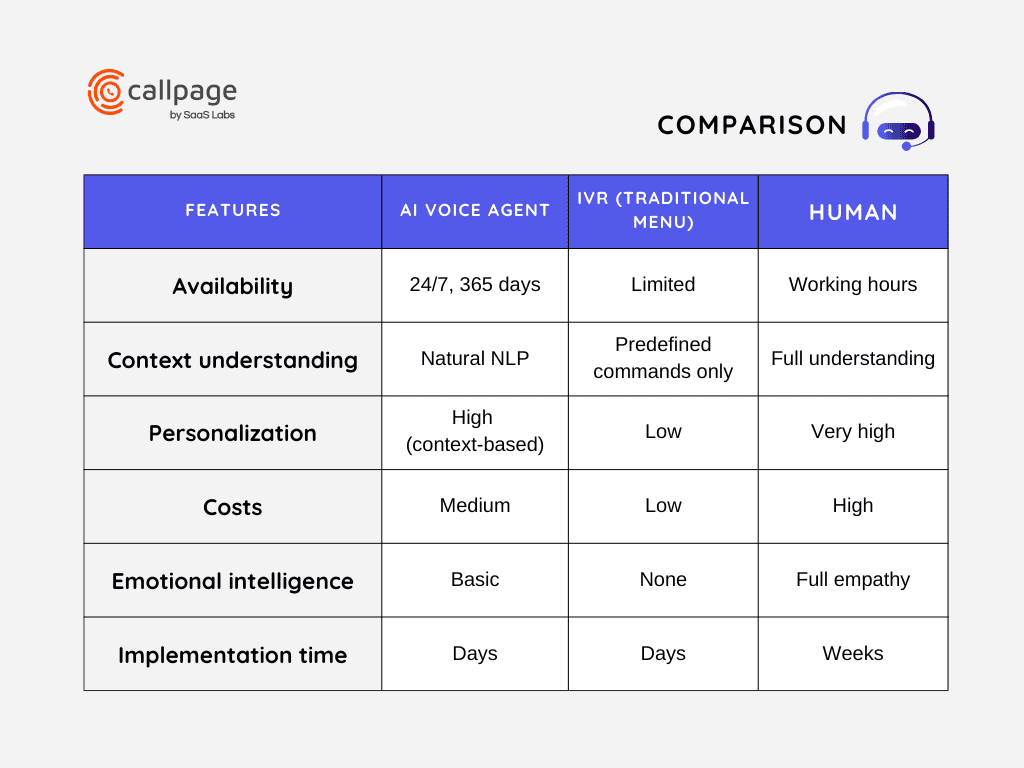
Unlike a human receptionist, an AI receptionist can be deployed across multiple locations and departments, each with its own business hours and routing rules, providing scalable and consistent service.
AI solutions remain available in all circumstances, enabling quick responses and efficient customer service. Implementing an AI receptionist can also significantly reduce operational costs compared to traditional call handling methods while supporting modern inbound call center sales techniques.
In practice, no solution is perfect for every scenario—the best results come from a hybrid approach.
AI tools for phone automation
The market for AI-powered phone automation is growing rapidly. Available tools generally fall into several categories:
- AI voice agents - Intelligent voice assistants capable of natural conversations (e.g., Synthflow, Vapi, CallPage AI Voice Agent, Bookipi AI Receptionist—an AI-powered virtual phone assistant designed for small businesses and freelancers).
- Conversational AI platforms - Platforms for building voice and text bots (e.g., Google Dialogflow, Amazon Lex, Microsoft Azure Bot Service).
- Call automation systems - Solutions for automating inbound and outbound call centers (e.g., Twilio, Five9, JustCall—whose AI receptionist is built into its cloud communication stack and learns from user behavior over time).
- AI built into CRM systems - AI features integrated with platforms such as HubSpot AI or Salesforce Einstein Voice.
AI-powered solutions are also tailored for specific industries, such as legal services, where they enhance client intake, scheduling, and lead generation for law firms, and healthcare, where they support healthcare lead generation and patient appointment booking. Choosing the right tool depends on the business size, call volume, integration requirements, and language support.
Integrations with other systems
Integration with Google Calendar allows the AI receptionist to check real-time availability and automatically schedule appointments, preventing double bookings or errors.
Integrating an AI receptionist with your business website can streamline customer interactions, such as booking appointments and closing deals, while providing a professional online presence.
Integration with CRM systems ensures that every conversation, inquiry, or status update is instantly recorded in the customer database, improving relationship management and sales processes and enabling smarter call and lead distribution across your sales team.
A voicebot connected to company databases can access information such as customer history, previous contacts, or order status during the conversation—without involving additional resources.
Setting up an AI receptionist requires inputting key company information into a knowledge base or central library to ensure accurate and efficient responses.
AI voice agents can also connect with chatbots and analytics systems, enabling deeper automation and a better customer experience.
Choosing the best AI receptionist
The market for AI receptionist solutions is rapidly expanding, with a variety of providers offering tools tailored to different business needs. Leading names include CallPage, which specializes in converting website visitors into real-time sales calls or scheduled meetings through an AI-powered widget. CallPage’s AI voice agent stands out for its seamless integration with existing phone systems, advanced call routing, and robust analytics.
Other notable providers include Intercom, Zoho SalesIQ, JustCall, LiveAgent, Talkdesk, and CloudTalk. These platforms offer a range of features such as virtual receptionist software, AI answering service, call forwarding, call recording, and integration with popular CRM and calendar tools. Some focus on delivering human-like voice interactions, while others emphasize multilingual support or advanced lead generation capabilities.
When evaluating AI receptionist providers, consider factors like ease of setup, compatibility with your current systems, the ability to handle inbound calls and schedule appointments, and the quality of customer support. Comparing these aspects will help you find a solution that aligns with your business goals and delivers a superior customer experience.
Setting up an AI receptionist
Getting started with an AI receptionist is typically a quick and straightforward process, designed to minimize disruption and maximize efficiency. Most providers offer an intuitive setup interface that guides you through each step, making it easy even for those without technical expertise.
Begin by configuring your business hours so the AI receptionist knows exactly when to answer calls and when to route them elsewhere. Next, customize the greetings and messages your callers will hear—this personal touch helps reinforce your brand and ensures a welcoming experience for every customer.
Integration with your existing phone system, CRM, and other business tools is usually just a few clicks away. This connectivity allows the AI receptionist to access customer data, manage call handling, and streamline follow-up processes. To ensure the AI can answer calls accurately, provide it with detailed information about your business, such as services offered, pricing, and frequently asked questions.
By following these steps, you’ll have an AI receptionist that not only answers calls efficiently but also enhances the overall customer experience. This streamlined approach to call handling supports business growth by reducing missed calls, improving response times, and freeing up your team to focus on more complex customer needs, especially when paired with strong client communication best practices.
CallPage AI Voice Agent – how it works
CallPage AI Voice Agent, an ai phone receptionist designed for companies that want automation without complex implementation or high upfront costs.
How does the CallPage AI Voice Agent work?
The agent answers incoming calls, conducts conversations based on the company’s configured knowledge base, and responds to customer questions in real time.
It can operate in two ways:
- Within the CallPage website widget – when a visitor clicks “Call”, the conversation is initiated or handled by the agent
- Through a virtual phone number – the agent answers incoming calls to a dedicated company number
Key features
- Handling and qualifying incoming calls
- Context-based routing to appropriate consultants or departments
- Responding to inquiries using the company knowledge base (FAQ, pricing, offers)
- Automatic appointment scheduling with calendar integration (available from April 2026)
- 24/7 availability without breaks or vacations
- CRM integration with automatic data recording
- Conversation transcription and advanced analytics
- All conversations are organized and available for analysis without needing multiple tools or manual data searches.
"Configuration does not require technical expertise. In the dashboard, users can easily define conversation scenarios, upload a company knowledge base, and configure routing rules. The entire process usually takes only a few hours. The most time-consuming part is creating the company knowledge base - the more precise and helpful the agent’s responses will be.”
— Katarzyna Samsonova, AI Expert at CallPage
Can AI fully replace phone support?
This is one of the most common questions from businesses considering AI for customer service. The answer is not entirely—and that’s not the goal.
AI receptionists are excellent at structured, repetitive tasks such as answering calls, qualifying callers, responding to common questions, and routing conversations.
However, conversations requiring empathy, negotiation, complex problem-solving, or relationship building still require human involvement.
The best model: AI + human
Companies achieving the best results adopt a hybrid model:
- AI answers the first call, qualifies the caller, and collects information
- Simple inquiries are handled automatically
- Complex issues are transferred to specialists
- After the call, AI records the data in the CRM and schedules follow-ups
This approach significantly reduces missed calls, shortens response times, and relieves the team—without sacrificing service quality.
FAQ – frequently asked questions
Does an AI receptionist understand languages other than English?
Yes. Modern AI receptionists can understand and communicate in many languages, not just English. Many solutions now support languages such as Spanish, German, or French, and they are getting better at recognizing regional accents and everyday speech.
For example, advanced AI voice agents can handle conversations in French, including common phrases and colloquial expressions, allowing businesses to serve local customers naturally and efficiently.
How much does an AI receptionist cost?
Costs depend on the provider and pricing model. Options include monthly subscriptions, per-minute billing, or packages tailored to business size.
CallPage is available as a fixed package that includes all costs - such as phone numbers, call forwarding, minutes, and knowledge bases. Detailed pricing information is available at https://callpage.ai/.
How long does implementation take?
For SaaS platforms, implementation can take from a few hours to several business days.
Can AI replace a receptionist?
AI can handle most call-related tasks such as answering, qualification, providing information, and scheduling appointments. In relationship-focused businesses, it works best as support rather than a replacement.
Which industries use AI receptionists?
Common industries include: car repair services, medical clinics and specialist offices, construction and installation companies, real estate agencies, courier and logistics companies, any business where the phone is the main communication channel.
Are conversations with an AI receptionist secure?
Data security is a priority for AI providers, who implement advanced security measures, comply with industry standards, and undergo regular security audits. Reputable providers use data encryption, follow GDPR requirements, and ensure that their systems and customer information are properly protected.
Before implementing an AI receptionist, it’s a good idea to review the provider’s privacy policy and check how call recordings and conversation transcripts are stored and managed.
Try the CallPage AI Voice Agent
If you want to see how an AI receptionist could work in your company, the easiest way to start is with a 14-day free trial of CallPage. During the trial, you can create your own AI agent and test its functionality at no cost.
Summary
Implementing an AI voice agent is a step toward modern, automated customer service that can directly improve business results.
Using natural language processing and artificial intelligence, a virtual AI receptionist can hold natural conversations with customers, answer common questions, and schedule appointments in real time—all without involving staff in repetitive tasks.
This type of solution not only improves team productivity but also enhances service quality and allows businesses to focus on the more complex aspects of customer relationships.
Check out other posts
Start generating leads today!
Start a 14-day free trial now,
set up the widget on your site, and see how many more leads you can capture with CallPage
- No credit card required
- 10 minutes set up
- 14 days fully-features free trial